- Good
- Adequate
- Marginal
- Weak
- Poor
Frontal Impact
Lateral Impact
Rear Impact
Comment
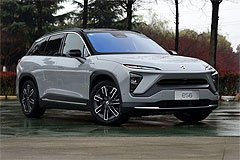
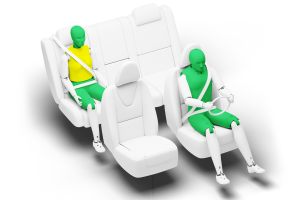
The passenger compartment of the EL6 remained stable in the frontal offset test. Dummy numbers showed good protection of the knees and femurs of both the driver and passenger. NIO showed that a similar level of protection would be provided to occupants of different sizes and to those sitting in different positions. Protection was good for all critical body areas of the passenger, and good or adequate for the driver. Analysis of the deceleration of the impact trolley during the test, and of the deformable barrier after the test, revealed that the EL6 would be a benign impact partner in a frontal collision. In the full-width rigid barrier test, protection of all critical body areas was good for the driver, and good or adequate for the rear passenger. In the side barrier test, dummy readings indicated good protection of all critical body areas. However, analysis showed that the curtain airbag had not deployed correctly, getting caught on the trim of the B-pillar. A penalty was applied to the head, and protection rated as adequate. The same penalty was applied to the head in the side pole test, although the airbag deployed correctly in this test. Control of excursion (the extent to which a body is thrown to the other side of the vehicle when it is hit from the far side) was adequate. The EL6 has a centre airbag mounted on the driver’s seat to mitigate against occupant to occupant injuries in such impacts. This performed well in Euro NCAP's test, and provides equal protection to the front driver and passenger. Tests on the front seats and head restraints demonstrated good protection against whiplash injuries in the event of a rear-end collision. A geometric analysis of the rear seats also indicated good whiplash protection. The EL6 has an advanced eCall system which alerts the emergency services in the event of a crash. The car also has a system which applies the brakes after an impact, to avoid secondary collisions. NIO demonstrated that if the car entered water the doors, if locked, could be opened within two minutes of power being lost and that electric windows would remain functional long enough to allow occupants to escape.